SBA loans make it easier to start, buy, or grow your business.
Traditional business loans are hard to qualify for, require significant down payments, and have high interest rates. So why barter with banks for good loan terms when you can work with Guidant to find lenders who want to bankroll your loan? SBA loans make it easier to get the money your business or franchise needs.
Lower Interest Rates
SBA loan interest rates are lower than traditional business loans, making repayment less of a burden — which gets you to profitability faster.
Flexible Down Payment
SBA loans can be combined with other forms of financing — like unsecured loans or 401(k) Business Financing — saving you on out-of-pocket costs.
Easier Loan Application
With Guidant, your application goes to our extensive lender network, which means you get more options and a competitive advantage.
What Is SBA ?
SBA loans are small business loans made by approved lenders like banks and credit unions and partially guaranteed by the U.S. Small Business Administration, helping qualified borrowers access favorable rates and repayment terms. In most cases, the SBA does not lend directly to business owners but instead supports lenders by reducing a portion of their risk. These loans can provide up to $5 million in funding and may be used to start or buy a business or franchise, expand operations, purchase equipment or commercial real estate, or support working capital.
There are several SBA loan programs available, and Guidant can help determine the best option for you.
Lenders usually look at five main factors when reviewing an SBA loan application. These are often called the “5 C’s,” and together they help show whether you are a strong candidate for financing.
The 5 C’s of SBA Loan Eligibility
Capital
Lenders want to see that you can contribute to the project, usually through a down payment. This shows you have your own stake in the business. The amount needed depends on the loan and the business, but other funding sources, like 401(k) business financing or unsecured loans, can sometimes help cover it.
Credit
Your personal and business credit history matter. Lenders often review your credit scores and look for a pattern of responsible borrowing. Recent issues like bankruptcy or major delinquencies can make approval harder.
Capacity
Capacity is your ability to repay the loan. Lenders look at your income, the business’s expected or current cash flow, and your overall financial picture to decide whether you can handle the monthly payments.
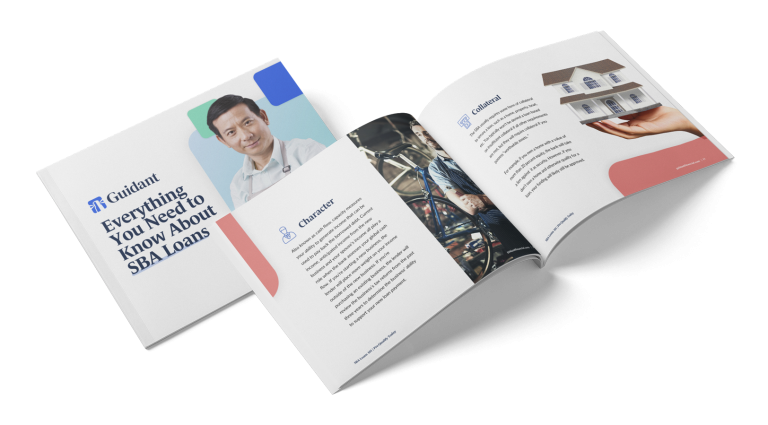
Character
Lenders also consider your background, experience, and overall reliability as a borrower. Business experience can help, and they may also review parts of your personal history as part of the application process.
Collateral
Collateral is property or other assets that may help secure the loan. In some cases, lenders may place a lien on personal assets, such as a home. Not having enough collateral does not always mean a loan will be denied, but it can affect the decision.
You do not need to be perfect in every area to qualify. Lenders look at the full picture, and all five factors work together when they evaluate your application.
While there is more than one type of SBA loan, the process is generally similar across the programs Guidant supports, including SBA 7(a), SBA Express, and the 7(a) Working Capital Pilot (WCP). Guidant helps simplify the process by helping you prepare a strong application, connect with the right lenders, and reduce unnecessary back-and-forth along the way.
Pick Your Business or Franchise
Before applying, you need a clear business plan and a defined project. Whether you are starting a business, opening a franchise, buying an existing company, or expanding your current operation, lenders will want specific details about what you plan to do and how much funding you need.
Determine Your Financing Needs
Once you know your project, the next step is determining how much capital you need. This usually includes startup or acquisition costs, equipment, working capital, real estate, and other key expenses. Clear financial projections help show lenders that your request is well thought out.
Find a Lender
After that, you will need to find a lender that is a good fit for your deal. Guidant helps by packaging your information, presenting it to multiple lending partners, and helping you compare your options so you can move forward with the offer that best matches your needs.
Complete Your Application Package
Once you choose a lender, you will complete the full loan application and provide the supporting documents required for underwriting. This often includes financial statements, projections, tax returns, business details, and background information on the owners.
Move Through Underwriting and Closing
During underwriting, the lender reviews your credit, financials, collateral, business plan, and overall borrower strength. Some SBA lenders have delegated authority to approve certain loans without prior SBA review, while others must submit the loan to the SBA as part of the process. Once underwriting is complete and the loan is approved, you move into closing by completing the lender’s final checklist so funds can be disbursed.
How much can I qualify for with an SBA loan?
Your SBA loan qualification amount will depend on the type of business you’re looking to open. Most banks will require at least 20 percent down for existing businesses or franchises and around 30 percent down for most startups. If you divide the amount of money you’re willing to invest by the percentage down required, you’ll get a rough idea of how much you can qualify for. Lenders will want to be sure you still have significant cash reserves (about three to six months of expenses) left over after your investment into the business, so factor that into your calculation.
Is it true that I only need 10% down?
Not exactly. The SBA has a minimum down payment requirement of 10 percent — but that’s the floor, not the ceiling. Each lender has their own guidelines for how much of the loan they’re willing to finance, which impacts how much your down payment will be. Though it’s possible to only put 10% down, most lenders require a higher percent to mitigate their risk in taking on the SBA loan.
Is using my 401(k) to fund a business a tax loophole?
ROBS is not a tax loophole. In 1974, Congress passed the Employee Retirement Income Securities Act (ERISA), which works in conjunction with specific sections of the Internal Revenue Code (IRC) to make ROBS a legal, legitimate strategy for accessing your retirement assets to start or buy a small business.
How long does an SBA loan take?
There are many factors that determine how long the SBA process takes. Business type (startup vs existing business), finding a location, and lender underwriting time, are all factors that play into the overall SBA loan timeline. The timeline is also very dependent on how quickly you can complete the lender the requirements and documentation. Most startups generally take 90 to 120 days, while most existing businesses take around 90 days on average. Working with Guidant can help you move this process along faster.
How much does it cost me to work with Guidant for my SBA loan?
Guidant charges a one time fee of $2500 for SBA consultation services.
What’s the minimum credit score for an SBA loan?
The SBA minimum for an SBA loan is a credit score 640. However, most lenders prefer credit scores at or above 700. More than just your credit score, lenders want to know your credit history and current debt obligations. High credit card debt or recent late payments factor into lenders’ decisions to take your SBA loan. Previous bankruptcies, foreclosures, or short sales are also items lenders want to know about, along with an explanation letter to help them understand the circumstances.
If the SBA is backing my loan, why would I need to put up my home as collateral?
To participate in SBA loan lending programs, the SBA requires that lenders underwrite SBA loans like there isn’t any government backing. That means that the SBA wants lenders to use the same collateral requirements for an SBA loan that they would have for a non-SBA loan. SBA-backing provides lenders extra security (and incentive to take on your loan), but the governmental backing can’t act as collateral, according to the SBA. That’s because the SBA won’t pay out their guaranty if the lender doesn’t follow their guidelines on “prudent lending.”
Do I need a business plan for my SBA Loan?
Yes. A business plan is one of the required documents for an SBA loan application. A business plan is a great exercise for you as a business owner, as well as the most helpful tools for a lender when evaluating your loan application. When you work with Guidant, we’re here to help you with your business plan and other information required by the SBA and lenders.
Can I use my retirement funds as a down payment?
Most of the time, yes. You can use 401(k) business financing, also known as Rollovers for Business Startups (ROBS), as an equity injection to cover some or all of your SBA loan down payment. By using your 401(k) business financing funds as your down payment, you can avoid early-withdraw or distribution tax penalties. To use 401(k) business financing, all you need is a rollable retirement account with at least $50,000. Guidant is an industry leader in 401(k) business financing, so we can help you understand everything you need to use your retirement funds as your SBA loan down payment.
If you don’t want to use 401(k) business financing, you might also be able to take a plan distribution or a 401(k) loan, but keep in mind the taxes and debt you may need to pay.
Get Money for Your Business in 3 Easy Steps

Pre-qualify
See your financing options and how much funding you can access with our two-minute pre-qual.
Pre-qualify Now
Schedule a Call
Schedule a call online with a financing expert to discuss the right funding options for you.
Schedule a Call
Get Funded
Get your money to start or buy a business. ROBS funding can be accessed in as little as three weeks.
Get Started NowWhy Work With Guidant?
We’re the Experts
We’re With You
We’ve Got Your Back

Cover Your SBA Loan Down Payment With 401(k) Business Financing
You don’t need to cover your SBA loan down payment out of pocket or with another loan. Instead, you can combine small business financing methods by using your retirement funds as the down payment on an SBA loan — without triggering any tax penalties or draining your personal savings.
While both SBA loans and 401(k) business financing have advantages as stand-alone programs, together they can set you up on a path for success with a higher funding amount and lower monthly payments.
What Guidant Customers Have to Say




Ready to take the next step?
Get in touch with a Guidant expert to find out which programs, and how much, you qualify for.